| (Note - I have not made thumbnails for the reference images - just click on the underlined text if you want to peek.)
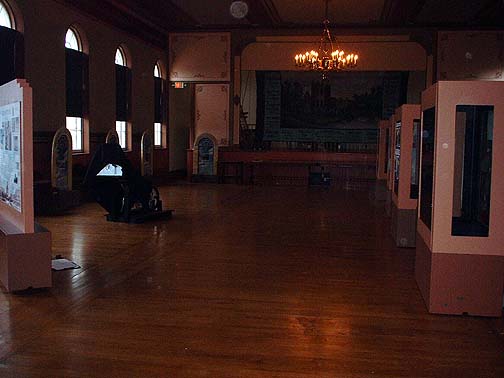
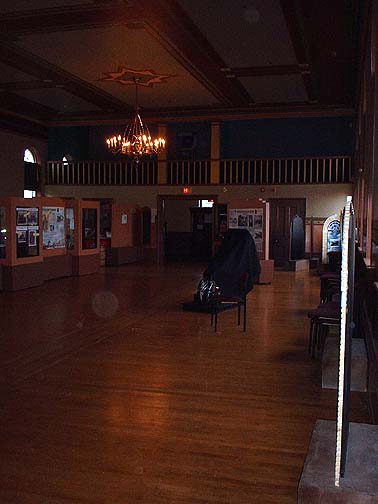
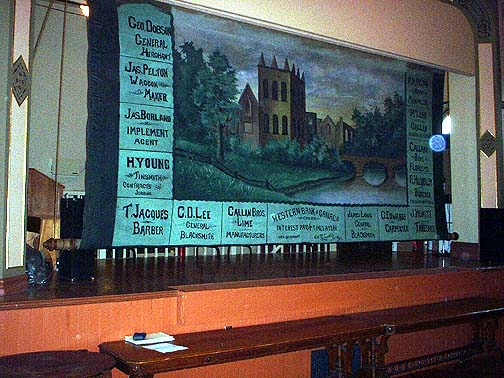
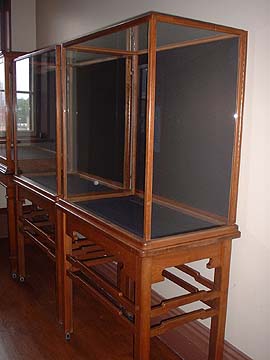
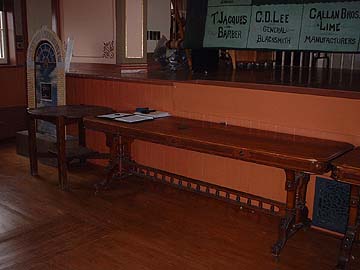
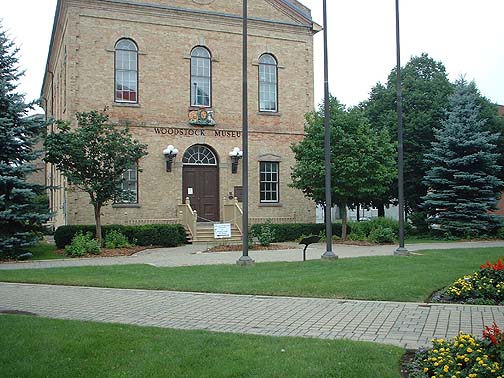
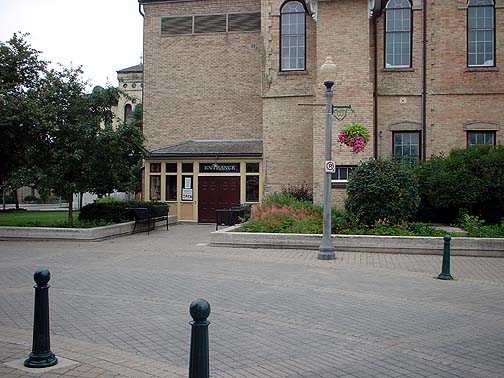
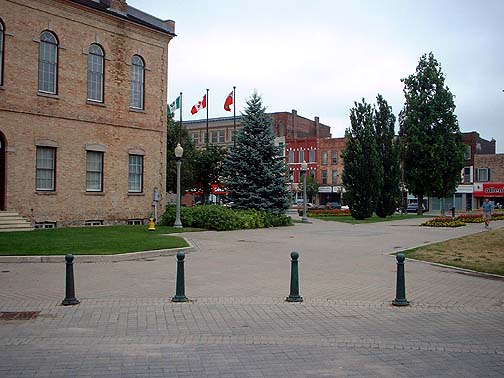
The exhibit is being mounted inside the 'Old Town Hall', on the SECOND floor of the historic Woodstock Museum. The overall space is quite large - roughly 60 x 40 feet. It has extremely high ceilings, lit with restored chandeliers. At one end is a stage area. A series of tall thin windows, starting about chest high, run down both sides of the space. View of the hall from the front entrance towards the stage - HERE View of the hall from the stage side door towards the front entrance - HERE The stage runs most the length of the south end of the hall. It stands up 45 inches from floor level. The total length is just over 20 feet. The depth is about 10 feet. There is an antique back cloth that can be removed, but a replacement back screen will have to be found. A closer view of the stage and backdrop - HERE One overall restriction is the lighting. There is considerable natural light from the two banks of large windows. The general lighting to the hall is provided by the two chandeliers is not particularly bright. Unfortunately, electric outlets to the main hall are limited. There are a total of FOUR duplex outlets available in the large room. Some extra power can be drawn via extension cables if required. Artists requiring specialized light ling should make a special request. If at all possible, try to provide your own lighting fixtures. The Museum has a number of large glass fronted cases which secure with locks. These all have glass on three sides, plus glass in the top (for light). There are a total of SIX antique cases: Four are 36 inches long by 20 inches deep by 36 inches high inside. The floor of these is waist high. Look - HERE One is 45 inches long by 20 inches deep by 32 inches high inside. The floor is waist high. One is 70 inches long by 20 inches deep by 50 inches high inside. The floor is lower in this case (the total height is the same as the others). There are also a total of FOUR modern styled cases. These are 42 inches long by 22 inches deep by 46 inches high inside. The floor is waist high. Taken all together, these cases represent a considerable volume to present smaller and more fragile pieces. The four modern cases will likely need to remain as seen in the photos of the hall interior - forming the dividing wall for the educational area. The other cases can be positioned as required on the open floor. There are also a number of smaller 'sculpture bases' available for smaller, durable items. There are a number of moveable plinth / wall units. A total of SIX of these in two sizes. Each has a low rectangular base with an upper wall area. The top portion is fitted so that foamcore boards can be installed on both sides. (The current posters can be quickly removed.) All stand a total of 82 inches overall. The upper wall portions are 58 inches tall. Look - HERE There are four units with base size 72 inches long. The attached boards are 64 inches long by 42 inches tall. There are two units with base size 48 inches long. The attached boards are 40 inches long by 42 inches tall. With the boards removed, we can attach work directly to the upright surfaces on both sides (depending on placement). Some of these panels will need to remain as part of the dividing wall, allowing only one side to be used. There are also three antique wooden tables in the room. All are a standard 30 inches tall. Look - HERE One is a round table at 36 inches diameter. Two are long rectangular, at 94 inches long by 28 inches wide. The Woodstock Museum sits right off the main street in the central shopping core of Woodstock. The building is set back behind a small park / square. There is a possibility to position much larger pieces outside around the Museum. There are some standing poles and light fixtures that would provide secure locking points. This would only be done if an artist has a particularly large piece. There has been some past problems with security / vandalism, so outside installations are not likely to be used. The view of the building front from the square - HERE The view of the side (east) main entrance - HERE The side area of the building, possible use for demonstrations? - HERE Loading The second floor hall can be accessed via the main front staircase or a rear staircase and elevator behind the stage area. The ceiling height of the first floor is quite high - 12 plus feet, which makes for long stair cases! The clearance at the front stair is maximum 40 inches wide. (Although for a past exhibit with enough man power, pieces 48 x 16 x 92" were carried in over the tops of the stair rails.) There are two long flights of stairs. Although there are wide clearances at the first floor, there is a bottle neck from the rear stage area to the main hall exhibit area. The door from the stage to the hall has a maximum width of only 30 inches. In the past, larger and longer items have been passed up and over the stage platform. There is a small elevator that lifts from ground level at the main (east rear) entrance. The doors open to the second floor on the direct opposite side. The doors are 42 inches wide. The interior of the elevator is 52 inches wide by 82 inches long (sorry, missed the door height). There is also a second stair case off the main entrance. The maximum clearance here is 38 inches.
ALL OBJECTS MUST ARRIVE AT THE MUSEUM NO LATTER THAN WEDNESDAY SEPTEMBER 3 I will personally be on hand at the Museum starting THURSDAY Sep 4. For Thursday and Friday I will be actually installing the exhibit. |