Click on any of these images for a larger size picture
Note - Most of the work since the establishment
of the Wareham Forge has concentrated in larger scale forged
objects.
I have undertaken fine metalworking projects, both as
commissions and for personal use.
These pieces are only a sample from a much larger body of past work...
|
Bloom Iron Buckles
2010 - 2012
|
This is a series of belt buckles,
commissioned over a period of several years, for a private
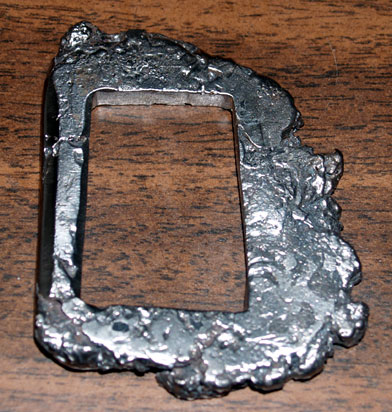
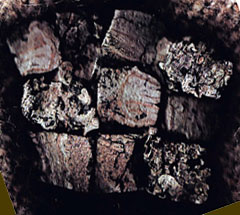
collector. All are created from small pieces of bloomery iron, and exploit differing qualities of this unusual material. (top left) - Here a bloom piece has been simply compressed from its 'raw' state (from extraction). The irregular surface has been wire brush polished for highlights on the irregular surface. (top right) - In this case the raw bloom was compressed further, at welding heat. The resulting slab was then the top ground until flat. Surface pitting and slag inclusions scatter over the bright metal surface. (bottom left) - Here the raw bloom has been folded and welded several times to a (mostly) condensed metal block. After forging to the dished shape, the surface has been polished and lightly etched. The motled colours are caused by variations in carbon content within the metal. (bottom right) - In this case, individual fragments of bloom, each varing in consistency and texture, have been formed to rough squares, then welded on the back surface into a solid plate. |
|
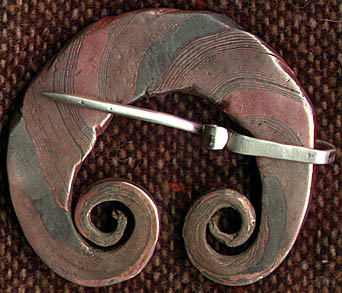
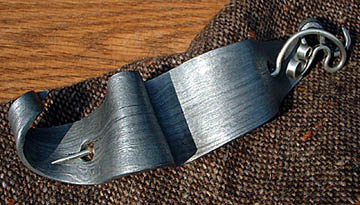
These two brooches show work taking layered materials and
using them in unconventional ways. |
|
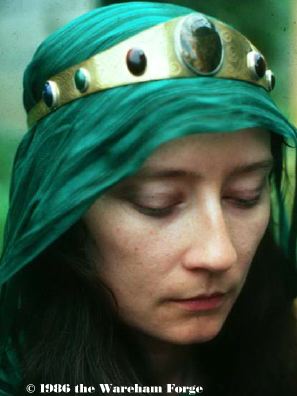
For a while in the mid 1980's I was caught with no real workshop - at least as far as a forge went. For a while I could not do much blacksmithing work at all. Still - the creative urge continued to drive me, and I turned to fine work. I had already been working with acid etching using hand painted ground as a decorative technique. I was also employed for almost three years as a casting technician for a major dental lab, this gave me great experience with working with precious metals in particular. The three objects pictured below are representative of a much large body of work. This is one of a huge number of circlets I have made over the years. (Part of my long involvement with Mediaeval re-creation.) These range from simple bands with single glass jewels to a set of elaborate crowns made with interchangeable plates (the Segmented Crowns of the SCA's Middle Kingdom). The one pictured here was a gift for Vandy Simpson (shown wearing it). The 'Celtic Chieftain's Daughter Circlet' (6/86) is a shaped band of 'borjay' gold (a bronze alloy), set with a total of seven semi-precious stones. The band is etched with a running knottwork pattern. |
|
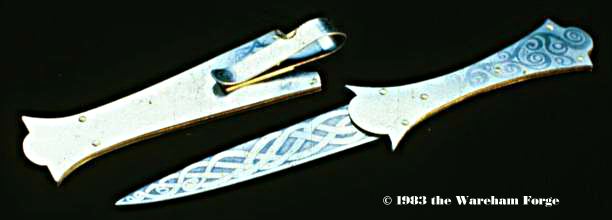
This knife represents a blending of bladesmithing with decorative metalwork. It was made as a gift for a woman who was a close friend (1983). In this case the blade is a commercial blank, which was modified and then etched. The handle and scabbard are made of nickel silver over a brass core - the assembly done with rivets. The etched patterns flow from handle to scabbard - or handle to blade, with different designs on blade and scabbard. |
|
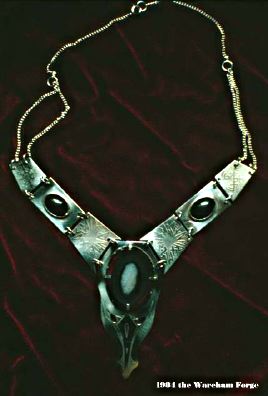
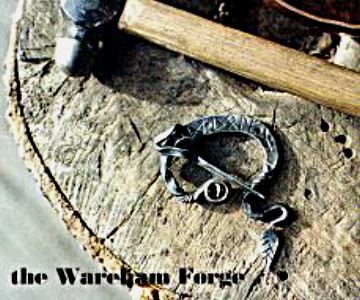
On the left is a pure fantasy piece - inspired by an illustration on an old Michael Morcock novel. The 'Hero's Pendant' (1984) was originally made as a show piece for an art show, and now is in a private collection. It is of nickel silver, set with a central geode slice and onyx cabs. The central plaque is a stylized wolf's head. The two Icelandic runic symbols are for 'strength' and 'divine protection' (Any SCA members in the Ontario region might be interested to know that this piece was the model for the 'wolf's head' symbol of Ealdormere.) On the right is one of my earliest forged steel jewellery pieces. The starting form echoes artifact iron broaches from the Viking Age. In early history, iron was an expensive enough material that jewellery objects were created of the material. Here a length of 1/4 inch square stock is forged into the decorative frame of the broach. One terminal end is wrapped to a spiral, the other formed into a leaf. The body of the frame is twisted and flattened, and hot punched with Norse runes, spelling out ' Old Wolf'. Despite the small size (about 3" wide) the piece has 12 individual forging techniques employed in its creation. |
|