| Boonstra, A., van de Mannakker, T., & van Dijk, W., 1997, ‘Experiments with a Slag-Tapping and a Slag-pit Furnace’, in Nørbach, L., (editor) Early Iron Production – Archaeology, Technology and Experiments, Historical-Achaeological Experimental Centre, Denmark |
| Elspelund, A., 1997, ‘i>The “Evenstad” Process – Description, Excavation, Experiment and Metallurgical Evaluation’, in Nørbach, L., (editor)Early Iron Production – Archaeology, Technology and Experiments, Historical-Achaeological Experimental Centre, Denmark. |
| Espelund, A., 2013, ‘The evidence and the secrets of ancient bloomery ironmaking in Norway’, Arketype Forlag, Trondheim, Norway |
| Nissen, M., 2005, ‘Eksperimenter med oldtidens jernudvinding På Ribe Vikingecenter 1999-2004’, Ribe Viking Centre, internet publication available at : https://ribevikingecenter.dk/media/10493/Artikel_om_Jernudvinding.pdf |
| Nørbach, L., (editor),
1997, Early Iron Production - Archaeology, Technology and
Experiments, |
| Noreland,
O., 2015, Technological
aspects of iron production at Skógar, Iceland AD 940 – 1305,
(Masters Dissertation), University College London Also available as PDF : https://www.academia.edu/36632076/Technological_Aspects_of_Iron_production_at_Sk%C3%B3gar_Iceland_AD_940_1300 |
| Pliener, R., 2000, ‘Iron in Archaeology – The European Bloomery Smelters’, Archeologicky Ustav Avcr, Pravha Czech Republic, 80-86124-26-6 |
| Rehder, J.E., 2000, ‘The Mastery and Uses of Fire’, MacGill-Queens University Press, Magill Press, Montreal Canada, 0-7735-2067-8 |
| Smith, K. P., 2005, ‘Ore, fire, hammer, sickle: iron production in Viking Age and Early Medieval Iceland.’ in De Re Metallica: Studies in Medieval Metals, AVISTA Studies in the History of Medieval Technology, Science, and Art, Volume 4, edited by Robert Bork et al.,. pg.183-206. Ashgate Press, Aldershot, UK. |
Experimental & Historic Iron Smelting on Video
A fuller collection on my YouTube Channel
|
|
|
|
| Experimental Archaeology : Prehistoric Iron Smelting Demonstration by Wessex Archaeology Experimental archaeologist Jake Keen demonstrates some of the concepts of iron smelting in a bloomery furnace using techniques believed to have been used during the British Iron Age. The demonstration was part of Wessex Archaeology's annual practical archaeology course. (October 2006 - length 4:50) |
Iron production in the Viking Age - Lofotr Viking Museum
by Aurora Borealis Multimedia Experimental iron production based on the reconstructed viking age technology. Bloomery iron production based on swedish furnaces from the Viking Age. Charcoal production based on knowledge from northern norwegian archaeological sites. The experiment was carried out at the museum in Lofoten under the supervision of K.G. Lindblad in 2003. (August 2007 - length 6:55) |
Celtic Iron Intro / 5 parts by 'Robin DV' Thijs van de Manakker, at Eindhoven, Netherlands. Each of the individual segments run about 9 minutes. They show the progress of preparing materials, building the furnace, smelting, refining the bloom and finally forging into a spear head. (December 2010) |
|
|
|
Video Posted to Facebook |
| Inagina : The Last House of Iron (preview) by Eric Huysecom & Bernard Augustoni Swiss archaeologist Eric Huysecom and cameraman Bernard Augustoni work with 13 master smelters to recreate the building of a traditional furnace for smelting iron in Mali. ... This film describes in great detail every aspect of the event, from the selection of the site of the reconstruction - which is the oldest remaining furnace site in the region, last active in 1961 - to the final result. (September 2008 - length 10:46) |
Dokwaza: Last of the African Iron Masters by Nicolas David ...the reenactment of a smelt by iron workers of the Mafa ethnic group shows a furnace type and a process that are unique to a part of the northern Cameroon and Nigerian border area. Includes preparing the furnace, the smelt, refining the bloom into a hoe. (1988 - length 49:0) | Smelting Iron to Ship Rivets by Vikingeskibsmuseet Roskilde Jens Olesen</b> smelts iron, based on Viking Age methods at The Viking Ship Museum. The iron, once converted into working bars, will be forged into ship rivets to be used in the reconstruction of the Skuldelev 3 boat. (December 2021 - length 7:06) |
Special thanks to :
| Forms the backbone team that I work with.
|

| the 'Gangue aux Fer' Without the guidance and friendship of these individuals, I would never have smelted iron. 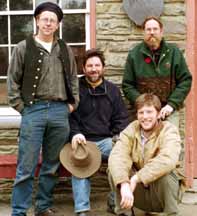 (L > R - at Early Iron 1, 2004) Lee Sauder Skip Williams Mike McCarthy |
Early Iron Experimental Group
" A collection of working metalsmiths,
historians and archaeologists. Our interest is using the
methods of experimental archaeology to develop working skills
related to the smelting of iron ores to workable metal using
historic techniques." The original Early Iron web site has been mirrored here And thanks to those who participated in : the Early Iron Symposiums (2004 / 2005 / 2006) Lee Sauder's 'Smeltfest' workshops (2006 / 2008 / 2011) |
I would like to specifically thank the friendship and mentoring of :
 Dr. Birgitta Wallace  Kevin P. Smith |
Text descriptions of papers and videos by the original authors indicated.
Text and photography © 1998 - present, Darrell Markewitz