|
|
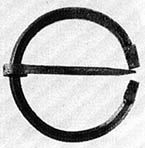
4.5 cm diameter
Staraja Lodoga, St Petersburg Russia / 8th Century
Viking to Crusader / Rosedahl & Wilson
page 300 / number 275
|
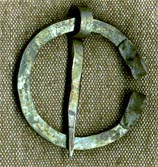
Replica 'Iron' Brooch
(shown life size)
|
This is the classic Pennanular Brooch, an elegantly simple version in forged steel with folded terminals. It
it is formed from 5 mm square stock and about 4.5 cm in diameter (3/16 x 1 3/4").
This type of brooch was popular with the Balts in the Viking Age, and is found from
Sweden through to Russia. It is very strong, easily able to hold a full wool cloak
- even when soaking wet.
Cost for IRON BROOCH - $25
|
|
|
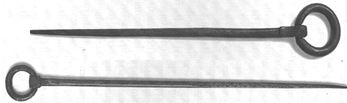
top - Beinnes, Sognog og Fjordanur, Norway
bottom - Hala ir, Eyjafjor , Iceland / both 10th Century
Vikings North Atlantic Saga / Fitzhugh & Ward
page 172 / figure 11.12 |
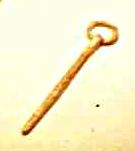
Reproduction Ring Pin
(shown life size)
|
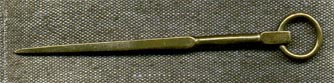
The bronze ring pin found at L'Anse aux Meadows. |
This is a reproduction of the famous Ring Pin found at L'Anse aux Meadows,
Newfoundland, Canada. It is cast in bronze (like the original). Total length is
10.5 cm, with thickness at the head of 5 mm (4 1/8 x 3/16"). Created in conjunction
with David Roberston.
This type of Ring Headed Pin is most common in Norway through Norse Ireland and
especially Iceland. It reached its peak of popularity about the turn of the first
Millennium.
Cost for RING PIN - $50
These mounts and pendants combine a high degree of historical accuracy
with a reasonable price. All these pieces are made of a modern lead
free pewter (92% tin alloy). Each piece is individually cast in a hand
carved soapstone mould, the same technique used by Norse metal smiths. Pewter,
when new, is very close to sterling silver in appearance, and was widely
used by the Norse 'middle class' because of this. The shiny 'fresh out of
the mould' finish duplicates the way these pieces would have looked when
they were originally made. Because of the total lack of lead in this modern
alloy, the metal will not tarnish with age as the old pewter does. Those
pieces mounted as pendants are strung on a leather lace, including six brightly
coloured glass beads. The beads have been carefully chosen to resemble Viking
Age types, and are hand made using similar methods.
All the replica castings are shown as life sized direct scans
|
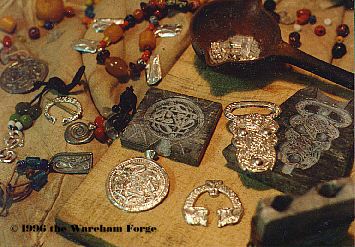
Soapstone moulds, castings and equipment.
|
| For a brief description of the process of Casting Pewter in Soapstone
Molds go HERE |
|
|
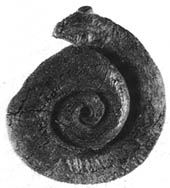
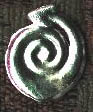
Dublin Serpent
A number of these coiled serpent pendants have been found throughout Norse
England. They are thought to be good luck charms. In Yorkshire, it is common
to find fossilized worms, which the Norse thought to be petrified snakes.
Artifact samples are carved from jet, amber, and wood - as in the original
from Dublin. |
3.9 cm
Dublin, Ireland / 11th Century
Viking to Crusader / Rosedahl & Wilson
page 334 / number 408
|
Dublin Serpent Pendant
|
Cost for DUBLIN SERPENT PENDANT - $20
|
|
|
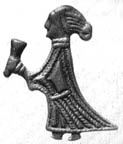
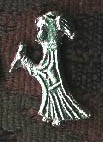
Valkyrie
We have found a number of small figures of women. Modern perception has
been to call any female figure bearing a horn a 'Valkyrie' - in keeping
with one of the function of those mythical figures. Considering the
social importance of mead, and the key role of women in hosting, that
simple view should be considered dated.
|
about 3 cm
Birka, Sweden / 10th Century
Viking to Crusader / Rosedahl & Wilson
page 277 / number 186
|
Valkyrie Pendant
|
Cost for VALKYRIE PENDANT - $20
|
|
|
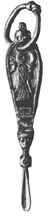
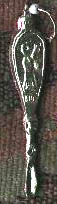
Ear Spoon
This is the most elaborately decorated of the samples of this type of
object found from the Viking Age. Many of these small spoon shaped
tools are found looped together with other grooming accessories.
(Note that this item comes mounted on a twisted wire loop bearing six glass seed beads - rather than on a thong.)
|
6.9 cm
Birka, Sweden
The Vikings / Graham-Capbell & Kidd
page 88 / number 180
|
'Ear Spoon' Mount
|
Cost for EAR SPOON MOUNT - $20
|
Original Designs
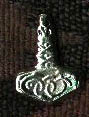
Thor's Hammer
|
The Hammer of Thor is the most enduring symbol of the Viking Age. Artifacts
have been front in a wide range of materials and levels of workmanship -
from simple carved wood to elaborate constructed goldsmithing. This version
combines a number of design elements from period samples : the classic shape,
coiled serpent on the head, line and dot ornament on the shaft, and the
dragon head terminal. |
|
Thor's Hammer Pendant
|
Cost for THOR"S HAMMER PENDANT - $20
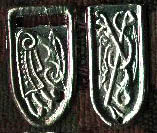
Strap Mounts
|
The strap mount was perhaps the single most common dress accessory of
the Dark Ages. It served a practical purpose - to strengthen the end of
tablet woven straps and bands. Artifact samples range from simple pieces
of wood with scratched designs through to elaborate gold mounts with inset
stone and glass (like the ones found at Sutton Hoo). Cast lead alloy mounts
were common as well. These original designs are based on two of the more
popular images from the Viking Age, The Wolf and the Eagle. Both are often
associated with the god Odin.
(These items sold as simple mounts - no thong or beads.)
|
|
Eagle or Wolf - Strap Mounts
|
For a short article on Strap Mounts go HERE |
Cost for STRAP MOUNT - $15 each
|