the Riddle of Steel: Layered Steel Blades


In all this world, you cannot trust gods nor men,
nor women or beasts.
In your sword alone can you trust.
But ever remember that a sword is not strength,
Strength is the hand that holds it.
Ever remember that a sword is not power,
Power is the mind that commands it....


Although some past work is shown here , the main portfolio of past work in bladesmithing is shown on the Gallery / Blades page.

Since ancient times, the bladesmith's dilemma has been how to produce a weapon that was both flexible enough to survive the impacts of combat, but at the same time hard enough to retain a keen cutting edge. Until modern times, the smith had basically only two ferrous metals to work with, wrought iron and carbon steel. Wrought iron is very flexible, bends easily, but is too soft to hold an edge. Carbon steel, on the other, hand can be made quite rigid and hard enough to stay a razor sharp. Unfortunately it is then also extremely brittle, so much so that any sudden blow will shatter it.

The most sophisticated solution to this problem, developed during the early middle ages, was the creation of layered steels. In simple terms, this process involves stacking up alternating plates of iron and steel. The pile is then welded under the hammer into a single solid block. The block is then stretched out into a long thin strip, folded, then welded again. This process is repeated over and over, to produce a billet of material that can be made up of many hundreds of layers. The blade forged from such a block is both flexible and hard, sharp but durable. After polishing, the metal is lightly etched, the two materials reacting differently to the acid to create distinctive lines on the surface. Ancient weapons made in this manner are amongst the most complex examples of the metalsmiths art.

Historically, there were three main areas that become known as makers of layered steels. The best known is the Middle East, where production was centred on Damascus during the 11th to 13th centuries. These blades were composed of the flat stacks described above, and were often elaborately decorated with etching and gold inlay. They gained such a reputation for quality that the term 'damascus' has come to be used to describe all layered steel, regardless of origin or technique.

The second area is Japan. The swords of the samurai are legendary in quality. Most of these blades are constructed of layered steel, produced of flat stacks. The highest quality weapons were produced here during the 14th and 15th centuries (curiously, after the first travels of Europeans to the East).

The other centre of layered steel production is little known, and actually predates the others. This is Northern Europe, especially Denmark and northern Germany. The height of manufacture in this area, both in quality and quantity, was during the 7th to 10th centuries. Unlike the other two centres, these northern smiths used a related technique called 'pattern welding'. In pattern welding, the blocks are initially stacked and welded as before. At this point, however, they are drawn out to thin, square rods. These rods are then twisted, usually matching but mirror images of each other. At this stage, the rods are then welded back into a solid block, with an edge wrap made of flat stacked material surrounding this core. Generally these blades have a lower total count in number of layers, but the use of the twisted core rods results in greater flexibility. The resulting blades have distinctive herring bone patterns running up the centre after etching.

Much emphasis is often placed on the total layer count as a measure of the quality of the blade. In truth, those blades with layer counts in the multiple hundreds to one thousand range are often of lower quality as weapons then those with fewer layers. At the high temperatures that are needed for welding, a phenomenon called carbon migration begins to take place. This, combined with the extreme thinness of the layers and the repeated welding, can produce a block of material that has very little variation in carbon content between the layers. Those blades that have layer counts of less than two hundred seem to have the best qualities as weapons. Experience has shown that pattern welded blades that have a layer count between 100 and 200 will exhibit the most vivid patterns.


(Short Cut HERE back to the site index / map.)


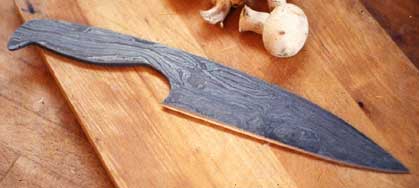
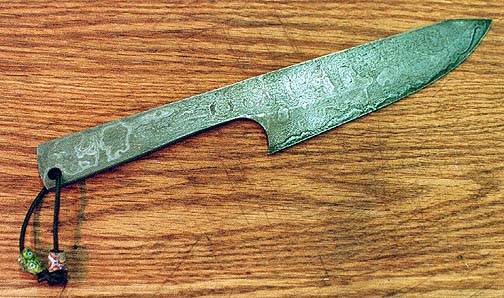
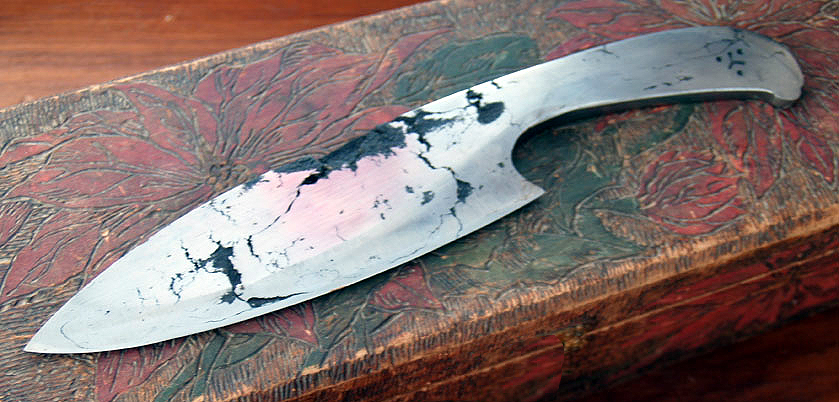
layered kitchen knife

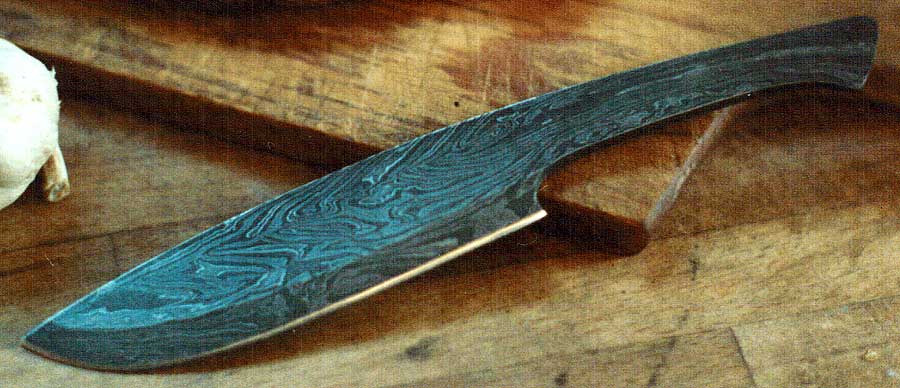
pattern welded kitchen knife - 1996
iron, mild and carbon steels - about 225 layers

The Wareham Forge produces layered steel blades using both the 'Damascus' (flat stack) and 'Pattern weld' (twisted) methods. The resulting knives vary in size and style. All forging is done using traditional methods, employing a coal fire. Although an air hammer is used to speed the process of drawing out the billets, all the shaping is done by hand hammering. All welds are percussion welds from the fire, rather than torch welding. Heat treating steps are done by eye, producing some variation in edge hardness, but generally yields a superior blade to those heat treated in ovens. The ferrous metal stocks normally used are a standard 1018 mild steel for the soft layer, 1045 spring steel, and 1095 carbon steel (about 1% carbon) for the hard. Special pieces may utilize layers of wrought iron or nickel. The standard practice is to layer two decorative layered slabs on to a solid high carbon steel core. This produces a blade that is a delight to the eye - but a the same time an excellent tool. The finished blades are polished to 120 grit, and then lightly etched to bring out the pattern. Although a few finished knives are kept on hand, usually all layered steel blades are produced as custom orders.


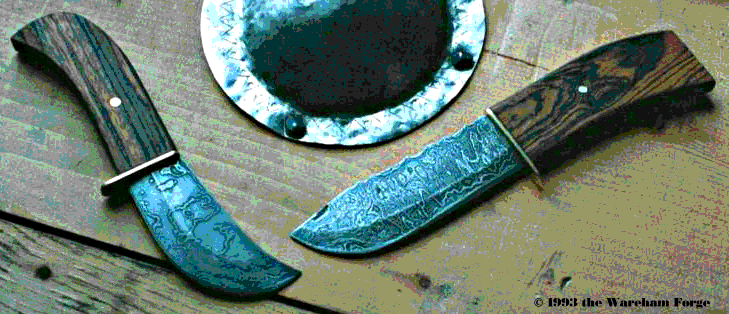
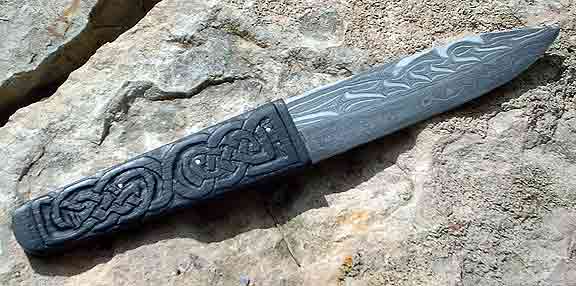
layered skiners

layered steel skinning knives - 1993 & 94
mild and carbon steels with antler hilts - about 75 layers

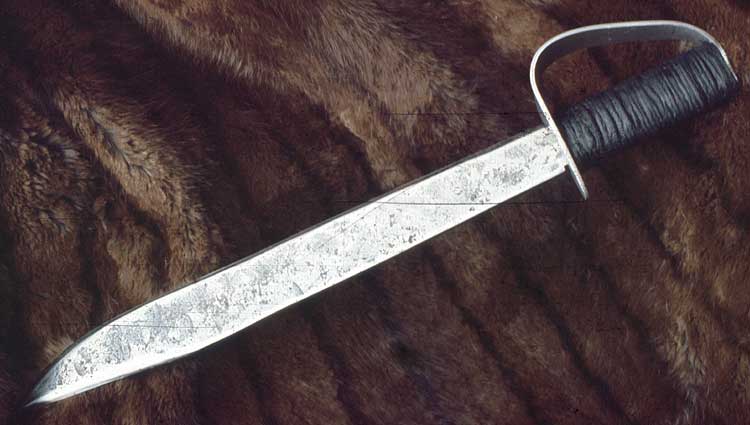
Past work by the Wareham Forge has included knives of all kinds as well as long arms. Functional knives have included skinning knives of functional high carbon steel. The samples pictured above consist of decorative layered steel slabs on high carbon cores - a combination that gives both beauty and a razor sharp edge. Mid sized heavy duty and combat knives are normally forged of 1045 spring steel. Long arms include socketed spear heads, axes of various sizes, and of course, swords - ranging from short combat swords to full sized broad swords.


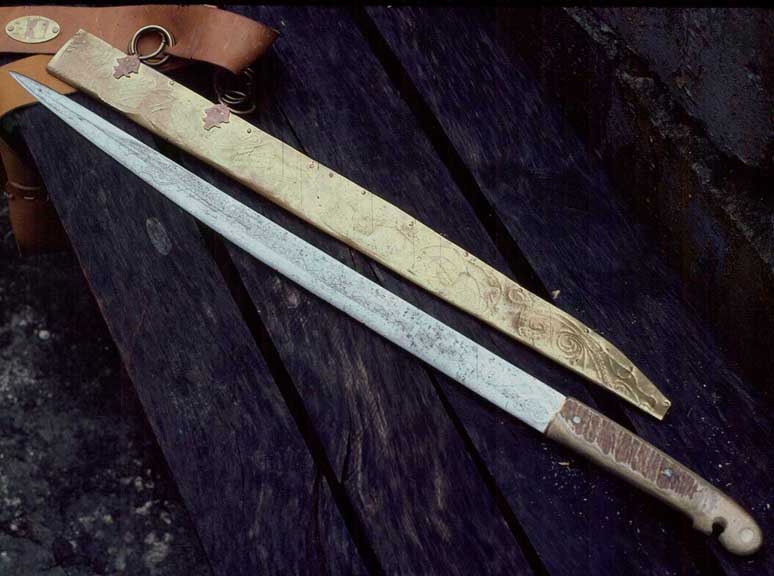
Norse weapons

Viking weapons group - sword, shield, spear and skull cap - 1997

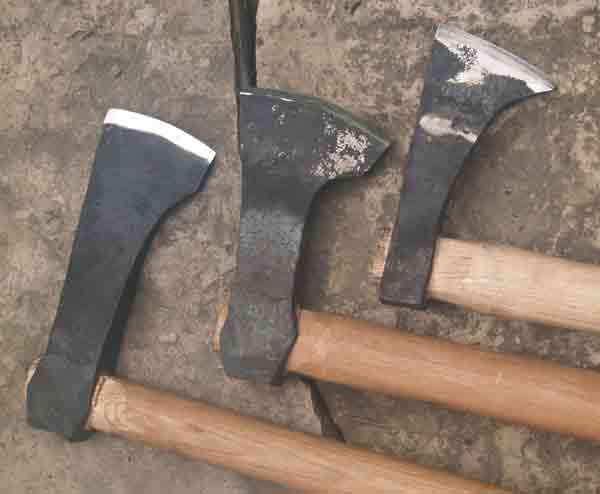
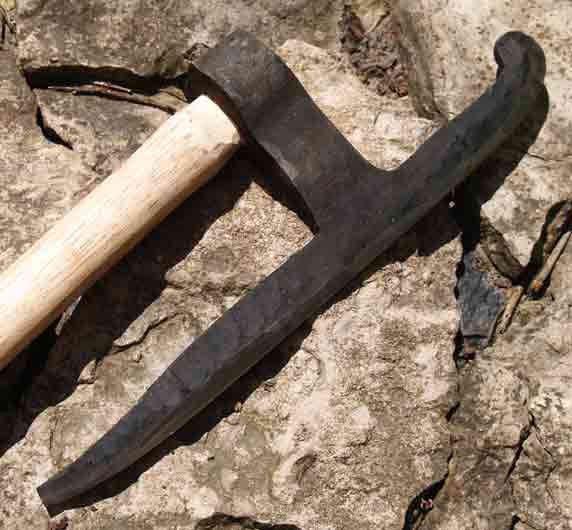
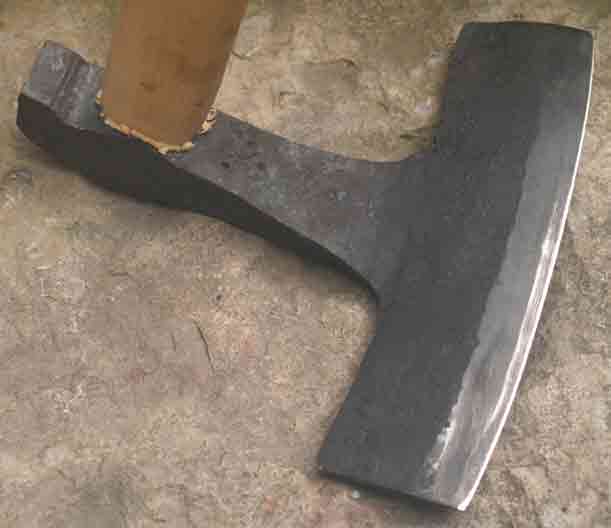
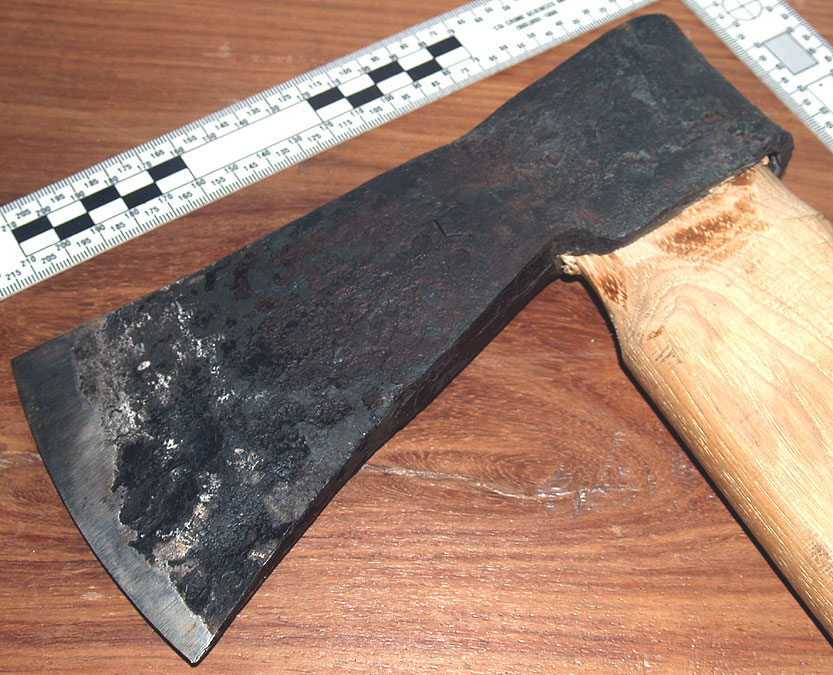
The Wareham Forge specializes in the creation of historic reproductions, and has extensive experience with all kinds of cutting edges. Past work has included various cabinet makers tools and cooking implements for 1800s living history museums. A particular area of expertise is the Viking Age. A large number of wood working tools from the period have been recreated for use in the Viking Encampment at the L' Anse aux Meadows NHS. This selection was based on the Mastermyr tool box (Norway, c 1100) and included various axes, chisels and draw knives. Specialized cutting tools can be created for the modern woodworker.


Norse tools

reproduction of the Mastermyr tool box - 1997
mild and carbon steels with maple handles

More examples of past work can be seen in the Gallery / Knives " section.

Interested in Knifemaking?

Check out the educational DVD "Historic Bladesmithing" available from the Wareham Forge.
'INTRODUCTION TO BLADESMITHING' is a 16 hour hands on program offered at the Wareham Forge.

Custom BLADESMITHING

by

the Wareham Forge

Prices revised January 2008

Knife sized blades are priced at a basic cost for hilting, plus a rate per linear inch of blade. Base price (at 4") includes a basic hilt of antler tube or hardwood slabs with a linseed oil finish. All knives come with a simple riveted leather blade cover. These are rough guidelines only and do not include shipping or required taxes.

Hilt extras: add brass guard on knife + $40
use of 'exotic' hardwoods + $20

Forged Carbon Steel Prices

Knives (of 1045 / 1090): single edge, first 4 " $70
double edge, first 4 " $80
both - per inch of blade over 4", add$15
rough forged only (x total blade length) $10

Layered Steel Prices

Flat stack ('Damascus'): single edge, first 4"$100
double edge, first 4" $120
per inch of blade over 4", add $30
rough forged (x total length) $20
'Pattern Weld' (twisted): single edge : two twisted rods each side of carbon steel core - first 4" $150
per inch of blade over 4", add $40
rough forged only (x total length) $30
double edge : two twisted + two flat stack edges - first 4" $200
per inch of blade over 4", add $50
rough forged $40

Note that these prices serve as a guide line only, each individual design must be quoted separately. Sword sized blades can also be created, but as they are considerably more difficult to produce, their cost must be individually quoted. The layer count for flat stack will be around 200, for pattern weld - cores at 9 to 11 layer, edges at about 75. Please ask for a quotation on more elaborate pieces. Sword sized blades can also be created, but as they are considerably more difficult to produce, their cost must be individually quoted.


Ordering information:

For full details go on

Please contact the Wareham Forge with your requirements and to discuss your project before placing an order. Remember that prices will vary based on the complexity of individual design, especially for larger and more elaborate items.


The Wareham Forge

The Hamlet of Wareham, R.R. #2 Proton Station, Ontario
CANADA - N0C 1L0

(519) 923-9219 // order@warehamforge.ca

Continue for more information on the following topics:

Training in Blacksmithing
Instructional Video
Bladesmithing
Re-Enactors Supplies
Viking Age Reproductions
the Norse Encampment
Gallery of Past Work
Just say Hello!

All text © 1998 - 2008, Darrell Markewitz - the Wareham Forge