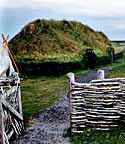
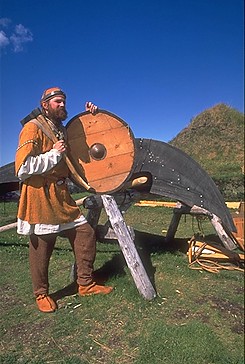
The 'Viking Encampment' is a seasonal living history program presented as an addition to the existing L' Anse aux Meadows National Historic Site. Opened in June of 1997, it centres on the compound surrounding the reproduction turf buildings already on the site. It consists of a collection of reproduction Norse artifacts, and is staffed by costumed historic interpreters. These staff members recreate the Viking Age, providing not only commentary on the period, but also portraying characters from the past. They are also involved in activities typical of the times, providing physical demonstrations of life styles and technologies. The Encampment area is open daily within the normal operating hours of the site. The conduct of this presentation is somewhat distinct from the present guide program at the museum but is fully integrated with ongoing activities.
Note: This information represents the original program as it was conceived and implemented in June of 1997. As with any good museum program, ongoing changes have been made since then to respond to changing conditions. The following information represents my own views and does not in any way represent the 'official' possition of either Parks Canada or L'Anse aux Meadows NHSC.

This series has been set up to allow for future additions and for easy navigation through the large amount of information provided. For that reason there is a separate index page, linked below. Here you can find short description of the other individual articles related to the Norse Encampment.

Specifically, this re-enactment represents aspects of daily life as it would have been carried out at the Vinland outpost and also is expanded to provide insights into the larger framework in Norse culture in general. A large number of reproduction artifacts have been introduced to the site: cooking gear, tools, navigation equipment and household goods like beds and chests. Small scale physical demonstrations of domestic and craft skills are undertaken throughout the day.
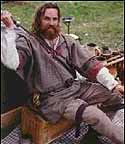
All interpreters wear the correct period clothing and have suitable personal accessories. They portray the characters of the ship's captain and his wife (a wealthy couple), as well as four others representing the common crew. (Four interpreters are working on any given day). The interpreters are using a 'role playing' approach, whenever possible, thus speaking from the point of view of their historic characters. This approach must remain flexible to the needs of the visitors however, and considerable modern commentary is also given. A total of four work stations are set up, one outdoors, the others in various parts of the main turf house:
Crew - This work station is set close to the entry gate and the reproduction faering already on site. The interpreter here is equipped with a selection of period tools and navigation instruments. In addition there are a selection of personal goods in wood storage chests, and a collection of simple cooking irons about a fire pit. Special attention is given to explaining ship construction and demonstration of Norse navigational aids in this area.
Turf 1 - This station is set in the main room of the large turf building. Here is found a cooking fire, with a collection of fire irons and pots. As well there is a collection of small household objects, (lamps, bowls, etc.). The demonstrations in this area focus on period domestic technologies, primarily open hearth cooking, which consists of the cooking of small flat breads (handed out to the public for 'tastes') as well as complete meals. Textile demonstrations include dyeing wool and spinning using a drop spindle. The role of women in Norse society is stressed here.
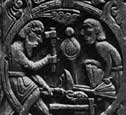
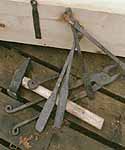
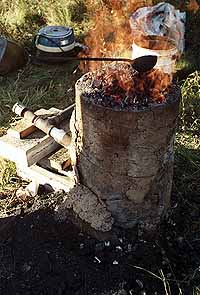
Turf 2 - This station is located in the second large room of the main building. The area contains a selection of personal effects including sea chest and sheep skin sleeping bag. A static collection of Norse blacksmithing tools can also be seen here. The main topic in this area is the production of iron at LAM and the role of the craftsman, with demonstrations centred on antler and soapstone carving.
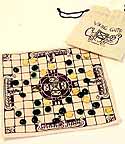
Turf 3 - This last station is set in the room at the north end of the longhouse. The artifacts here centre around a collapsible bed, and similar upper class personal goods. There is also a selection of trade goods and raw materials in this area. The emphasis here is on Norse social structure, with teaching of the game 'hneftafl' providing the main physical demonstration.
A large number of reproduction artifacts have been introduced into the site to illustrate Norse culture, provide for demonstrations, and generally provide life to the compound. About 200 individual objects have been specifically created for this purpose. Each individual item seen has been selected for a number of reasons. In most cases they reflect the types of equipment likely to have been present a L' Anse aux Meadows circa 1000 AD. Some items have been included to illustrate specific points about Norse culture in general, reflecting the Norse ties to settlements in Greenland, Iceland and Norway. To provide for the required historical prototypes, it was necessary to broaden the research base to include the archaeological finds of the Oseberg ship burial (Norway c 800 AD), the Mastermyr tool find (Sweden c 1000 AD) and the Coppergate excavation (England c 975 AD). Every reasonable attempt was made to produce objects that duplicate historic samples, but materials and techniques may vary because of availability, time and budget constraints.
![]()
This "The History Ring" site is owned by the Wareham Forge. Want to join the The History Ring? |
|---|
| [Skip Prev] [Prev] [Next] [Skip Next] [Random] [Next 5] [List Sites] |
![]() |
This Ring
of Vikings
site
|
|
The Wareham Forge
The Hamlet of Wareham, R.R. #2 Proton Station, Ontario
(519) 923-9219 // norse@warehamforge.ca