| Welcome to the Wareham Forge, the work of Artisan
Blacksmith Darrell Markewitz of Ontario Canada. Here
traditional hand forged techniques are blended with
original custom designs to create distinctive objects for
garden or architecture. (What is called 'wrought iron
work' by some.) A specialist in the Viking Age, creating
reproductions for Museums and re-enactors. Offering
training courses various aspects of Metalsmithing, plus
instructional DVD's. |
|
|
pull out guide |
 A reconstruction of the Burgess Shale site during the Cambrian explosion. Unknown artist - not credited (link to source). |
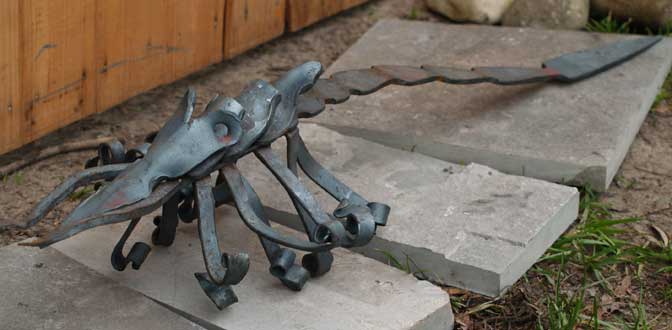 |
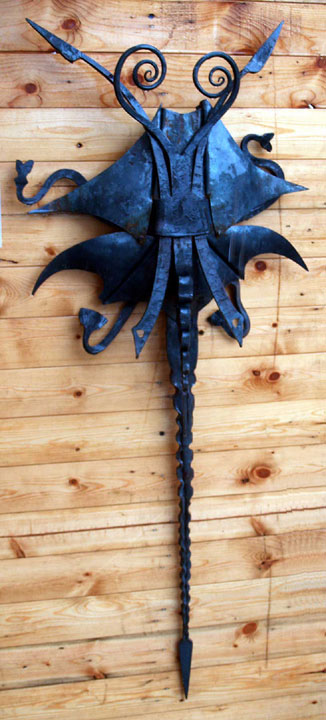
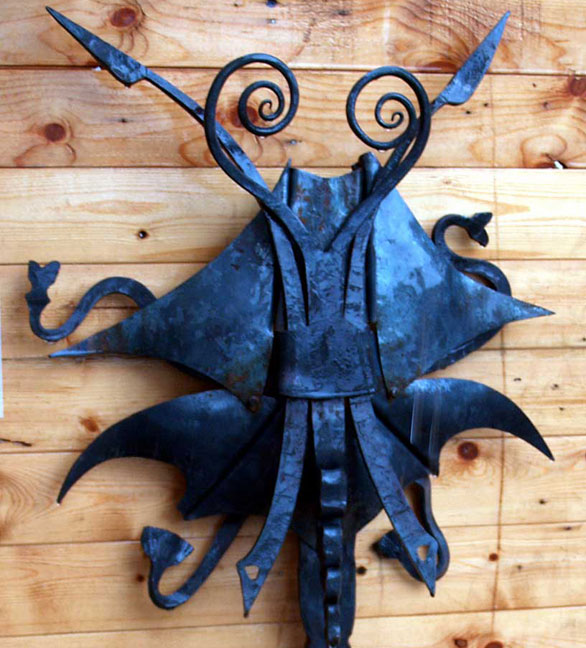
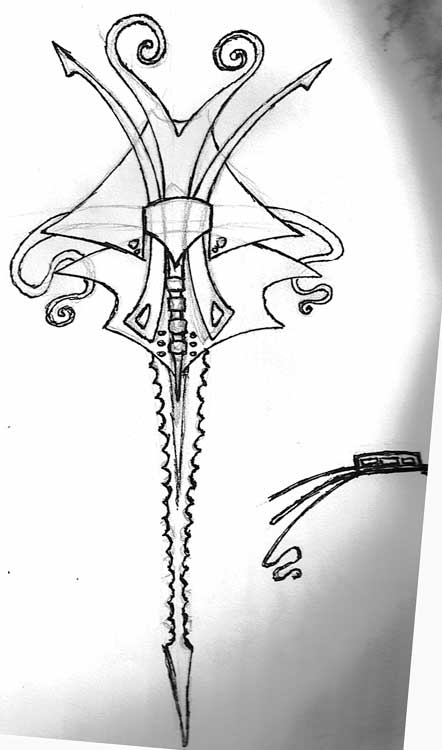
Summer 2009 (this object available - $500) This was the first piece in the Hallucigenia series. Although not nearly as weird as the real Hallucigenia (artist's interpretation to the right), it is strange enough. A set of overlapping plates make up the torso, ending in a long segmented tail. Are those legs or tentacles? Is this some proto-crustacean, ancestral insect, or just what. This monster is about 90 cm / 35 inches long. It has been left un-treated so it will naturally weather with time. |
 |
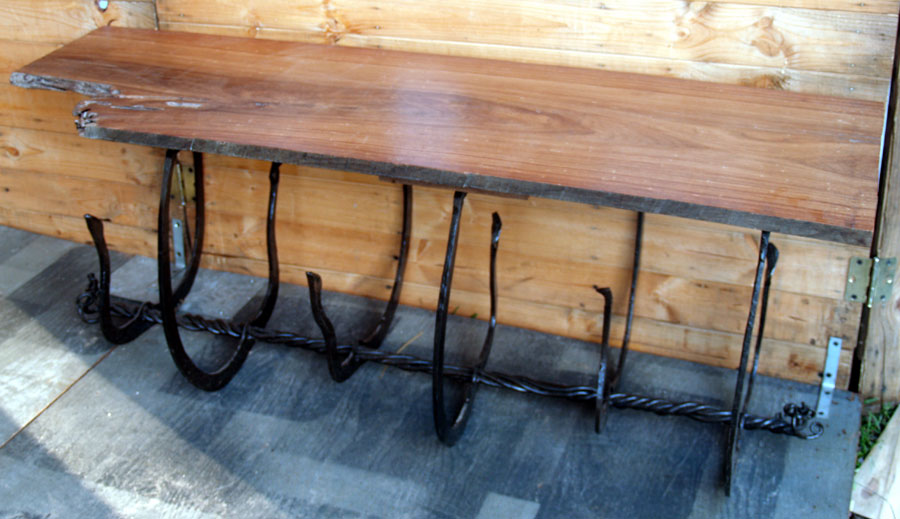 |
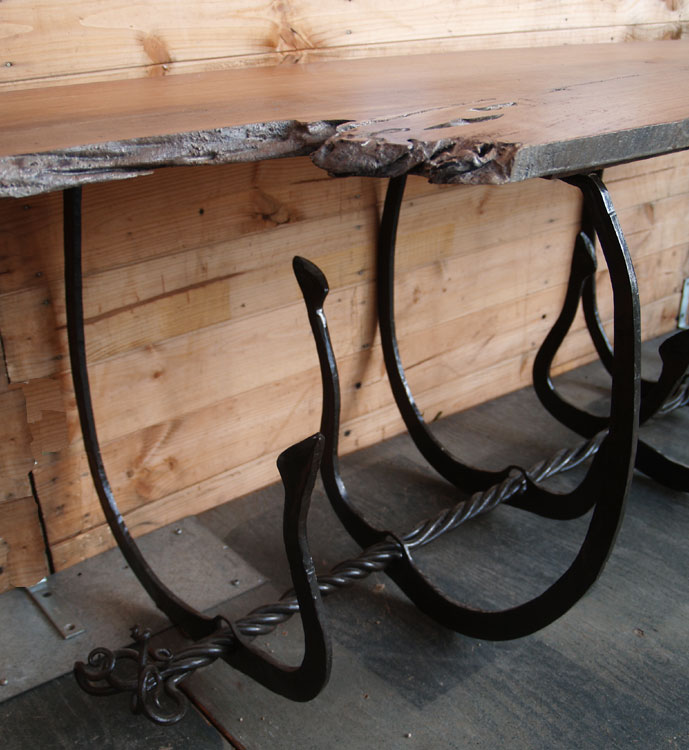
Summer 2010 (this object available - $700) The inspiration for this piece started with seeing fish
skeletons washed up along a beach. Imagine a series of
curved ribs, linked along a spine. But here the creature
has not yet developed a bony spine like modern animals,
but instead has a cable like nerve cord, twined together
to permit maximum flexibility. The individual ribs are
made from aggressively forged flat bar. To finish, the
metal is painted a dark chocolate brown. |
 |
|
||||
|
forged mild steel bar and sheet Summer 2011 This piece was created specifically for the 'Joined by Joints' category at CanIRON 8. I decided work from the *concept* of a joint, rather than the *function* of a joint - in this case the 'loop and wedge' technique. I also wanted to aggressively forge each of the elements, so much so that the profile of the starting bars would be completely transformed. The individual shell pieces are the only element that use a completely modern tool - these were torch cut from plate then ground to smooth lines. The folding technique here uses rivets to secure the lines. The two shell pieces and the spine are also riveted together. The curved 'antenna' elements work as wedges to secure in place against the central hoop piece. 'Burgess Crab' has been finished with a satin varithane coating, to preserve the natural fire scale colours. 'Burgess Crab' is now in the collection of J. Koza Ttee, who decided to purchase the work on its very first public showing. Image of the horseshoe crab by
Shubham Chatterjee, taken from Wikipedia.
|
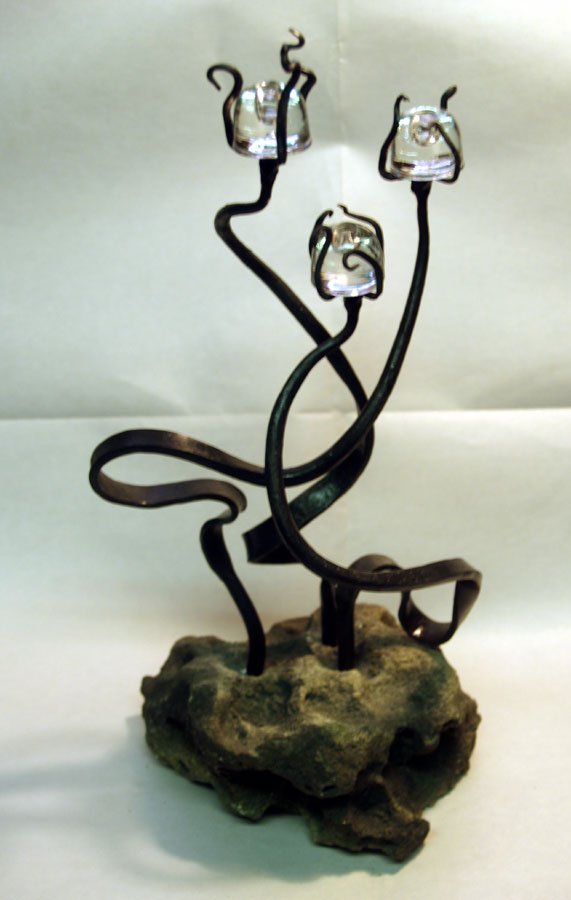 |
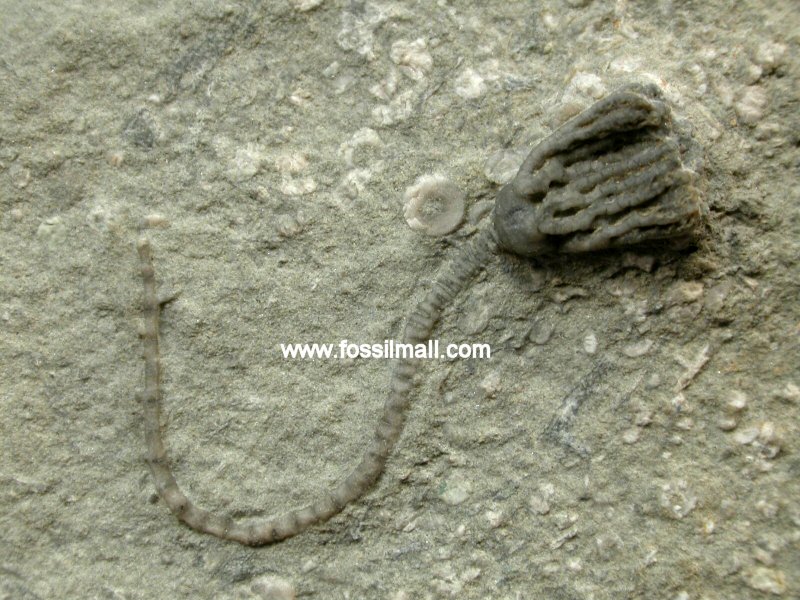
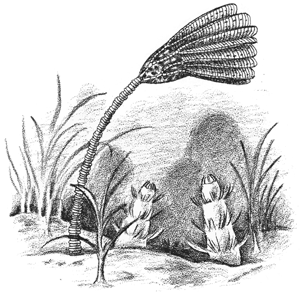
f orged mild steel with commercial glass, natural stone base Winter 2012 (private collection) The starting point here was a set of small thimble sized
glass holders for long thin 1/4 inch diameter candles. Images to the right: |
  |
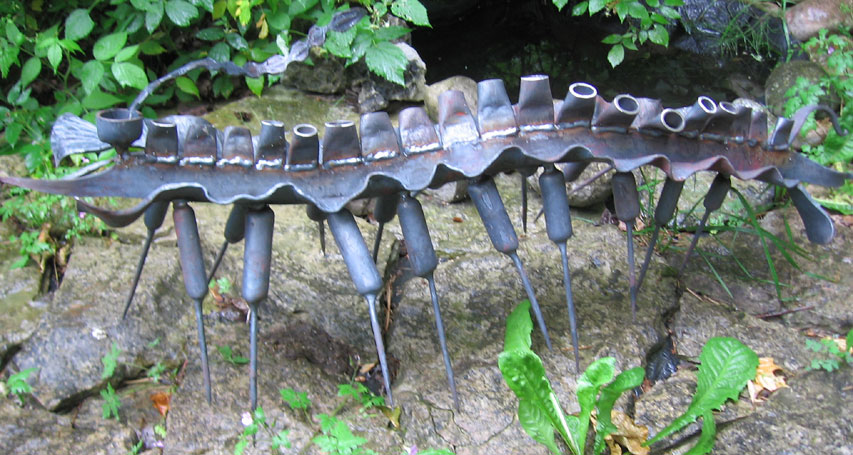 |
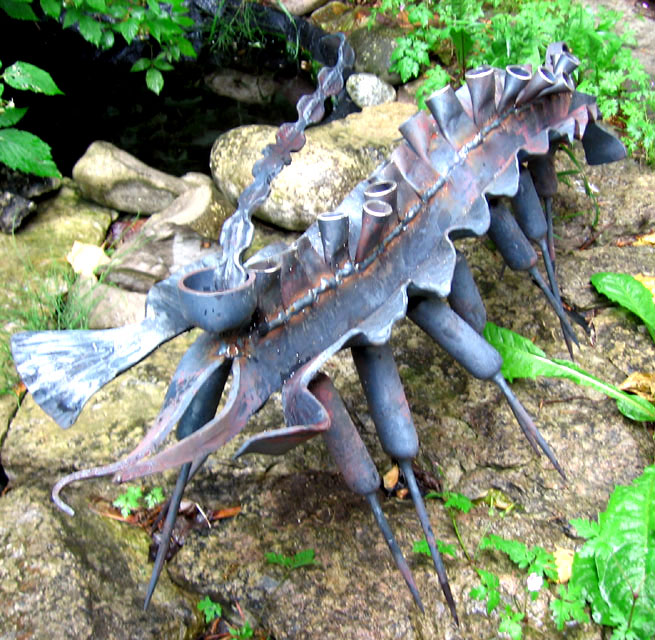
Summer 2012 (this object available - $500) The starting point here was actually a pail full of
offcut pieces of forged pipe, left over from work on the
architectural project on the Reade-Maxwell
House. Returing to the various illustrations of the
defining 'Hallucigenia' organism, the sauceage shaped
tubes were attached to short forged spikes to form the
legs. A body was formed by agressively forging a lenght of
channel, plus two pieces of angle. The short pinched
pieces became the ridges along the spine. |
 |
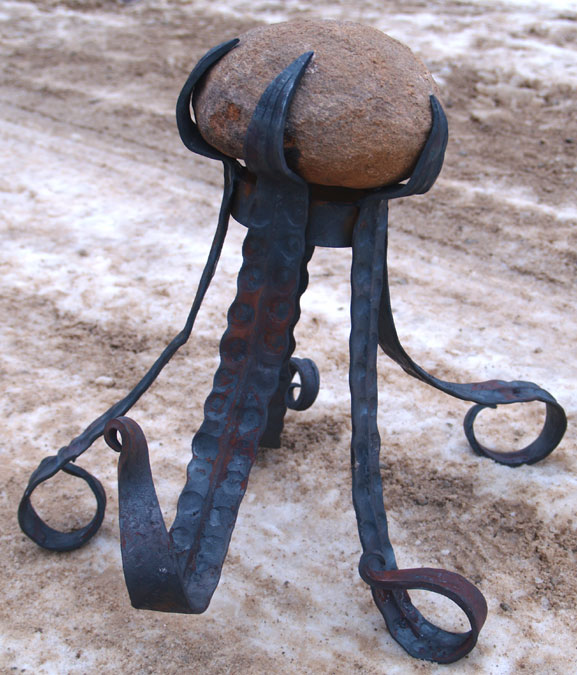 |
Winter 2013 (this object available - $300) During a workshop session with Kelly Probyn-Smith, I
started playing around with using various dies and surface
texturing tools to alter the surfaces of bars. One
prototype that emerged from this suggested a line of
suckers down a long tentacle. I had a number of smoothly
polished beach stones I had picked up somewhere on my
travels, intending to incorporate these into forged
pieces. |
 |
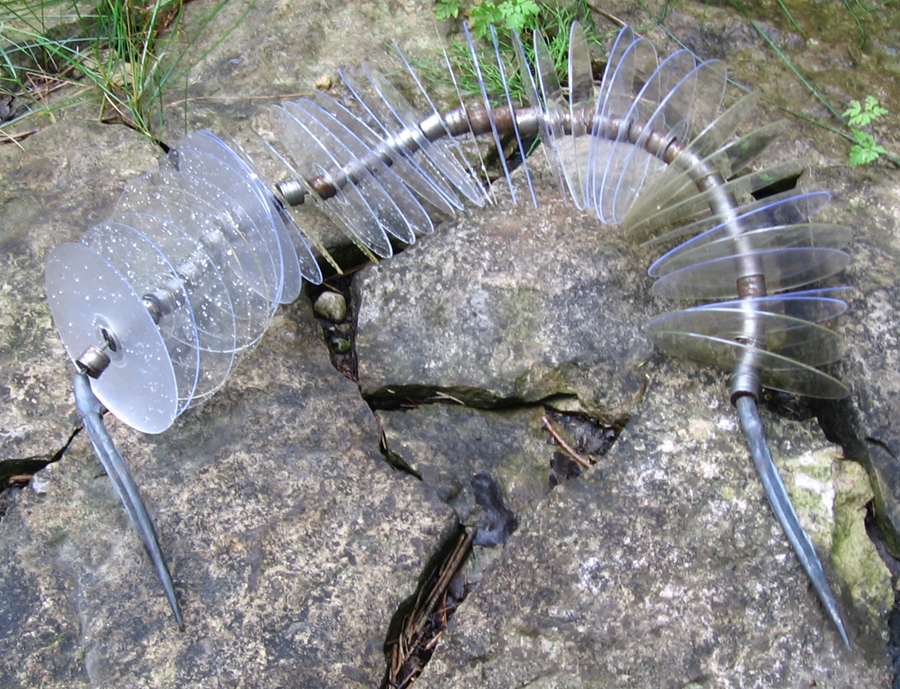 |
Summer 2013 (withdrawn) What if it was not legs, but wheels, that
Burgess animals evolved? 'Roller' has a flexible spine,
which may prove a bit of a reason why ease of motion (only
sideways!) is why this creature never survived to the
modern age? The starting point for 'Roller' was my accumulation of
those clear plastic disks that come with every package of
blank CD / DVD's. A series of short cut tube pieces space
individual disks along a section of wire cable. Both ends
terminate in a long forged spike. Overall about 60 cm (24
inches) long. |
 Who is Darrell Markewitz? |
|